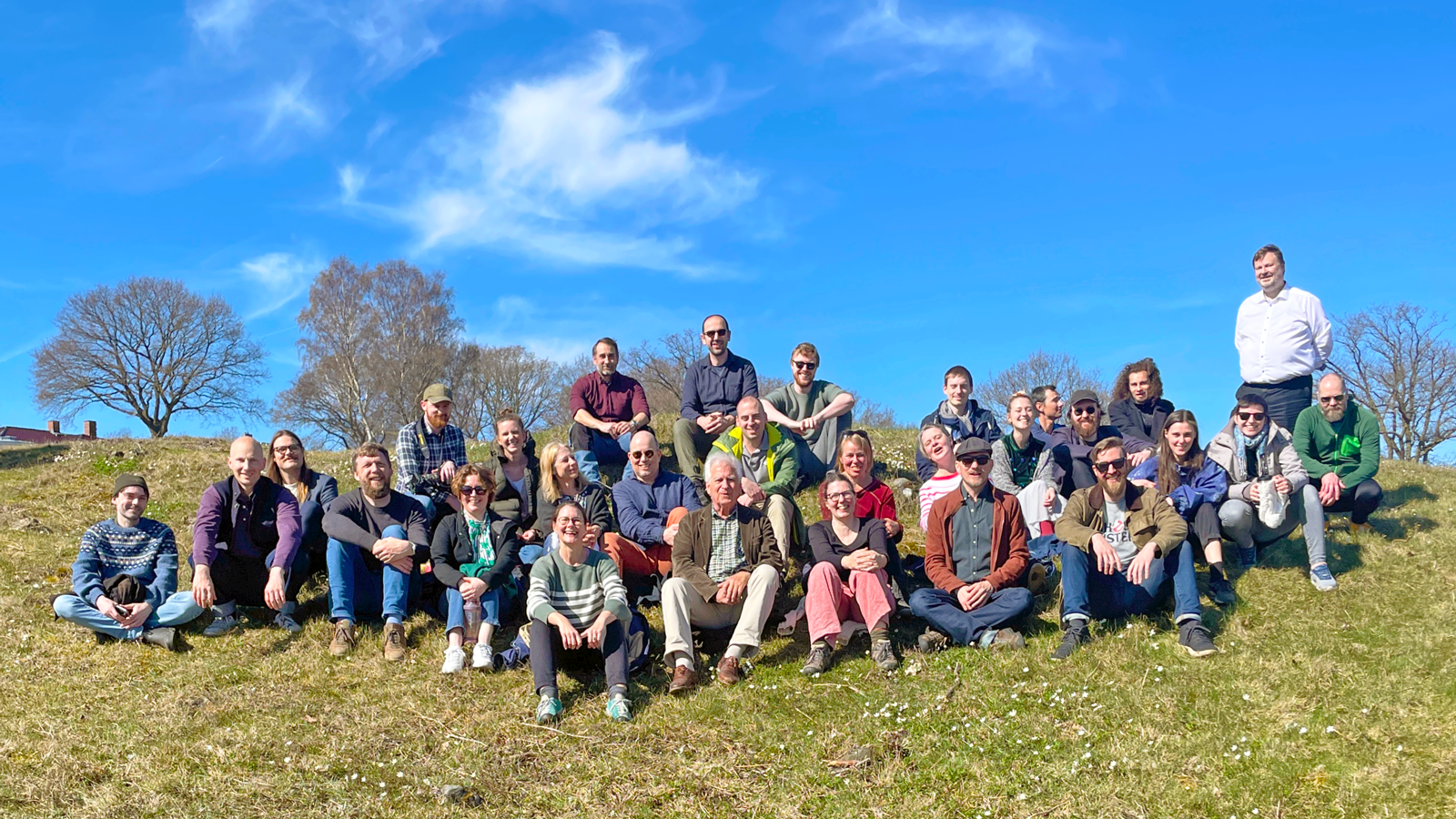
Welcome to Lund University Cognitive Science!

The main concern of cognitive science is the construction of models of human thinking - models which detail the processes intervening between environmental stimuli and behaviour. A shared assumption is that the mind is representational in nature and that cognitive processes can be described in terms of their function.

Read more 

Maria Larsson:
Learning Systems Thinking

Thesis Defence on December 14, 13.15 in room 104.
Opponent Professor Michael Baker.

Abstract
In the course of our educational life we are introduced to various subject areas, each with its specific way of representing knowledge. The challenge for the learner is to be able to think in ways that are supported by, and match, the representational format. A fundamental question for the science of learning concerns how this is achieved. In this thesis, it will be argued that by observing individuals collaboratively constructing their own graphic representations in a subject area that is new to them, it is possible to gain insight into this process. In the LUMES Master program, students are introduced to systems thinking and the method of creating Causal Loop Diagrams and interactive computer models for analyzing and solving complex problems. They learn how to use the terminology, symbols and methods of a specific semiotic domain. The research questions guiding the analysis of the empirical data concern how interacting with systems thinking tools affect students in the process of collaboratively analyzing and modeling complex problems, and how cognitive and semiotic resources are used in this process. The study provides a conceptual lens with which to discuss and perceive the complexity of learning to express knowledge with new representational tools: both its visual and spatial formalism and the related terminology. Three theoretical perspectives are applied: the socio-cultural perspective, the social semiotic, and the constructivist perspective. The sociocultural perspective is applied to emphasize the use of tools as a part of human learning. It puts focus on the mediating roles of language and other tools in a social context, which is in many ways connected to the social semiotic perspective. To view systems thinking and System Dynamics as a semiotic domain accentuates the use of specific terminology, symbols and gestures to express understanding. Furthermore, the constructivist perspective is used to put focus on the role of individual cognitive abilities and prior knowledge. Three empirical studies provide detailed analyses of video-recorded collaborative work in System Dynamics education. The case studies show how individual cognitive abilities together with language, gesture and the visual representations are used as integrated resources to express understanding of a problem and its solution.

A Smorgasbord of Cognitive Science

This new book edited by Peter Gärdenfors and Annika Wallin is an introduction to the breadth of current research in cognitive science, with the research at  Lund University Cognitive Science in focus. The result is a smorgasbord containing some of the cross-disciplinary issues in the contemporary debate.

Among the dishes: embodied cognition, learning, development and the brain, animal thinking, evolution, virtual agent, robots, interaction design, understanding, visualization, eye tracking, communication using technology, word meaning, everyday decision making, choice blindness.

The book is available from Nya Doxa.

Old News 

Contact Information

Address
Lund University Cognitive Science
Kungshuset, Lundagård
222 22 Lund

Expedition
Marja-Liisa Parkkinen Sjögren
10:45-12:00, 13:00-14:15

Phone
046 - 222 75 90
9:00 - 12:00, 13:00 - 14.15

Fax
046 - 222 44 24